From Compliance to Culture: Why Prevention Belongs at the Heart of Leadership
In a rapidly changing world of work, prevention is no longer a technical function or a compliance exercise. Organisations that perform well over time increasingly understand that safety, health and well-being are central to leadership quality, organisational culture and sustainable results. The question is no longer whether prevention matters —but how it becomes influential, credible and effective at the highest level.
Sabentis Written Interviews 2026
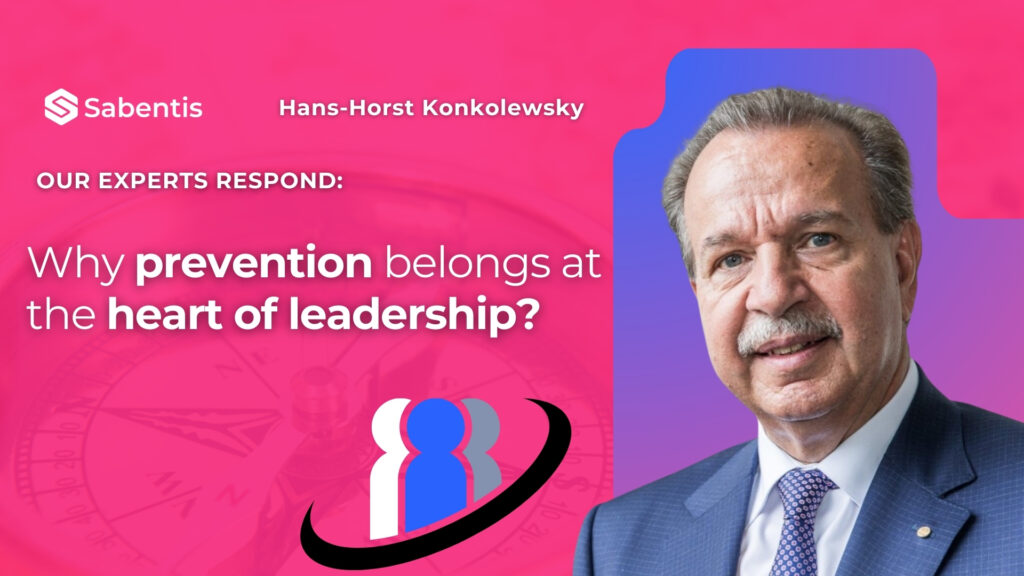
Hans-Horst Konkolewsky is President of the International ORP Foundation and one of the leading global figures in prevention, social security, and preventive culture.
He served as Secretary General of the International Social Security Association (ISSA) from 2005 to 2019, where he championed the concept of Dynamic Social Security, created the ISSA Centre for Excellence, and founded the World Social Security Forum.
Previously, he led the European Agency for Safety and Health at Work for a decade, spearheading the global promotion of a culture of prevention.
He is an official Vision Zero Ambassador, chairs the Global Vision Zero Business Council, and has received numerous international distinctions, including Denmark’s Order of the Dannebrog.
Prevention as a Strategic Business Imperative
Prevention becomes respected and influential when top management recognises that it is not only a legal or moral obligation, but a clear business imperative. Healthy, safe and motivated people are a decisive factor for strong performance, resilience and long-term value creation. When leadership understands prevention as the backbone of a socially sustainable business culture – where people genuinely come first – it gains strategic relevance. This shift is the core of building a real safety culture in the workplace.
This recognition must be translated into visible leadership commitment. Frameworks such as ISSA’s Vision Zero and ORP’s 5Z Culture help leaders embed prevention into everyday decision-making and leadership behaviour. When prevention becomes part of daily management practice and employees are actively empowered and involved, it turns into a shared responsibility and a genuine driver of organisational success.
Bringing Prevention into the Decision Room
Prevention gains a strategic voice when it is embedded in how decisions are made – not treated as an afterthought. Boards and executive teams that use a socially sustainable business culture as their leadership framework naturally integrate prevention into strategic discussions.
Practical tools and self-assessment approaches provided by Vision Zero and the 5Z Culture help decision-makers understand prevention as a driver of organisational resilience, ESG performance and sustainable growth. By clearly linking prevention to enterprise risk, reputation and value creation, it becomes directly relevant at the highest level of governance.
The Narrative That Resonates with Executives
At executive level, credibility comes from a narrative that connects people, performance and purpose. Safe and healthy work is a fundamental human right, a proven contributor to business results, and a key enabler of the Sustainable Development Goals. When prevention is positioned at this intersection, it aligns naturally with leadership priorities. That narrative is stronger when leaders can point to key safety KPIs that show real performance.
Vision Zero provides the strategic direction, with its Golden Rules and the 5Z Culture assessments translating ambition into concrete action. They demonstrate how prevention becomes real through daily leadership behaviour and organisational culture – making it both credible and actionable for top decision-makers.
Leadership Behaviours That Make Commitment Visible
Genuine commitment to prevention is demonstrated through actions, not words. Leaders who visibly care for people, consistently integrate safety, health and well-being into decisions, and invest in competence development send a powerful signal throughout the organisation. Knowing how to measure safety culture turns commitment into something visible and accountable.
This commitment becomes especially credible when prevention is prioritised even under operational or economic pressure. Encouraging employee participation, listening to concerns and valuing learning over blame create trust and transparency. When these behaviours are lived consistently, a healthy and socially sustainable business culture becomes visible in everyday practice.
Prevention Progress Is Built on Partnerships
Sustained progress in prevention is always built on a strong partnership architecture – both inside the organisation and across its wider ecosystem.
Internally, the most powerful partnership is the prevention coalition: top management, line managers, OSH professionals, HR, worker representatives and frontline teams working from the same compass. Vision Zero supports this alignment by turning prevention into shared responsibility and practice, particularly through its focus on leadership, competence and participation.
Externally, progress depends on collaboration with regulators, social security and accident insurance institutions, professional prevention networks, academia and innovation partners. These partnerships enable learning, benchmarking and the responsible use of new technologies. Global platforms such as ORP, ILO and ISSA provide the space to exchange good practice across regions and turn shared commitments into collective action.
Aligning Leadership, Culture and Results
Initiatives such as Vision Zero show how leadership intent, organisational culture and measurable results can be aligned in practice. They provide leaders with a credible framework that positions prevention as a core value and a strategic management responsibility – far beyond compliance.
Through its Golden Rules and practical guidance, Vision Zero helps leaders translate commitment into consistent daily behaviour. ORP’s 5Z Culture enables organisations to systematically assess and improve not only safety, health and well-being, but also environmental responsibility, transparency, inclusion and equality. As a result, prevention becomes more holistic, tangible and manageable: leadership quality, culture maturity and employee engagement can be measured, discussed and continuously strengthened – driving sustainable performance and long-term value creation.